
Ghosts of Christmas Past: Why the Victorians Loved Telling Ghost Stories During the Holidays
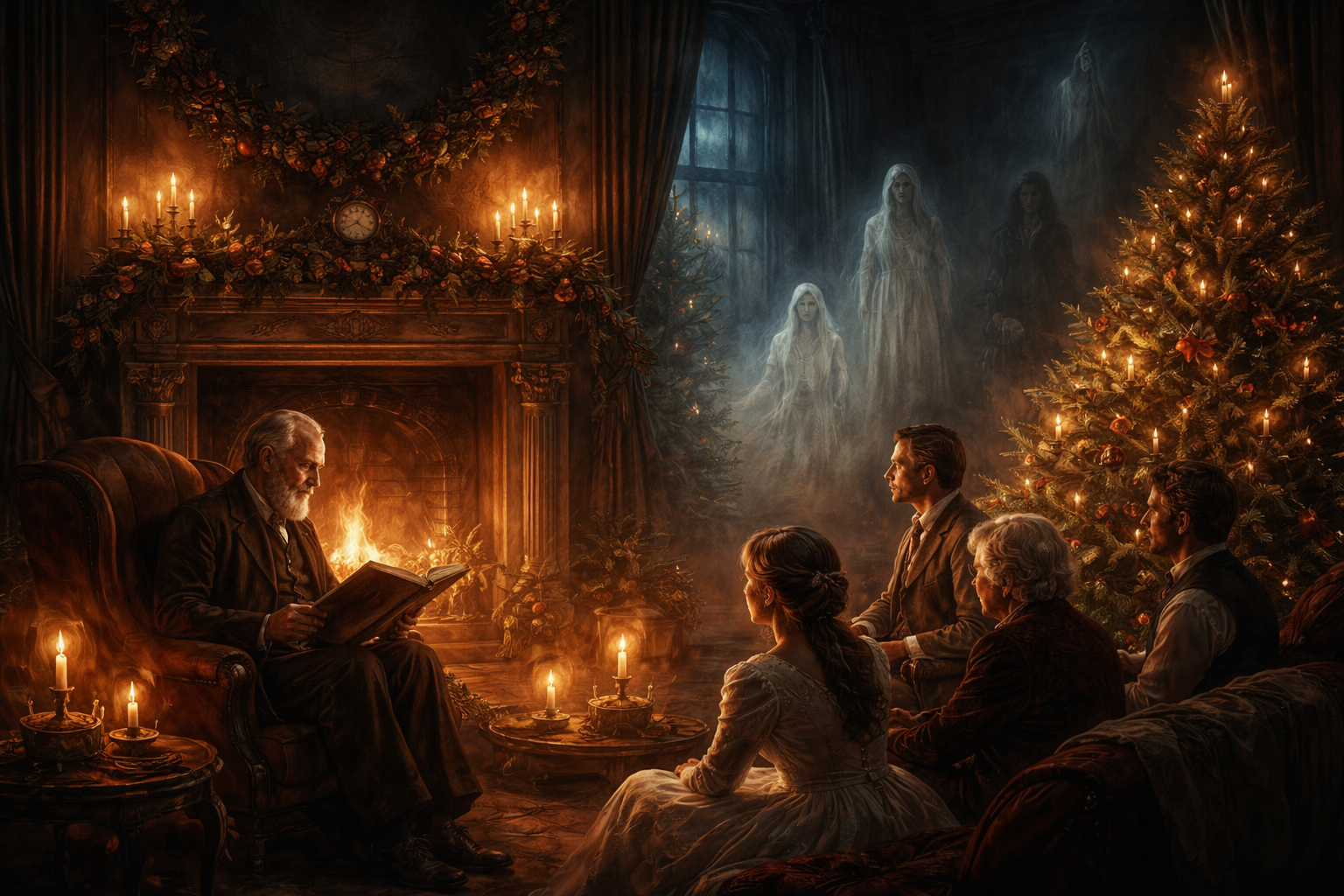
Victorian family gathered by a fireplace on Christmas Eve, listening to a ghost story, with candlelit decorations, a glowing Christmas tree, and faint ghostly figures in the shadows.
Twas the night of Christmas and all through the house,
People’s knees where knobbing and shaking about,
The fire erupted with holiday cheer,
As friends told of encounters with ghost, and goblins and creatures of fear.
When we think of Christmas, most of us imagine cozy fireplaces, jingling bells, and scenes of joyful family gatherings. But if you stepped into a Victorian living room on Christmas Eve, you might find something quite different: the flicker of candlelight, hushed voices, and the ghostly tones of someone recounting a tale of the dead returned.
In the 19th century, ghost stories were a key part of Christmas tradition as common as mince pies or plum pudding. This macabre habit may seem at odds with the season of goodwill, but it reveals much about Victorian culture, beliefs, and the way they understood both celebration and sorrow.
So why did the Victorians embrace the supernatural during the most festive time of year?
It all centers around ancient folklore, literary innovation, and cultural anxieties converging to make ghost stories a Christmas staple in the 1800s.
The Forgotten Custom: Christmas as a Time of Spirits
While we often associate ghost stories with Halloween, the tradition of telling them in winter dates to long before the Victorians. In pre-Christian Britain, the winter solstice marked a time when the boundaries between the living and the dead blurred. The Yule festival included stories of spirits and ancestral visitations, and these customs were eventually absorbed into early Christmas traditions (Winter, 2017).
As T. Moore (2025) notes in Victorian Christmas Ghosts, the winter months were a natural time for storytelling, especially when “darkness dominated the day, the world paused to reflect, and the veil between life and death seemed thinnest” [1].
In true Victorian custom, this “revival” of a deep-seated tradition tied ghost stories to winter’s stillness, death, and rebirth. After all, nothing says Victorian like taking something that already exists and then stamping it with new branding and claiming it as their own. True masters of rebranding and marketing.
Charles Dickens and the Ghost of Christmas Publishing
With all the re-writes, re-makes, and re-watching, it’s hard to recall that no figure shaped the Victorian ghost story tradition more than Charles Dickens, whose 1843 novella A Christmas Carol redefined the holiday. With its supernatural visits, moral introspection, and festive redemption, Dickens cemented the link between Christmas and the ghost story for Victorian readers.
Fun fact, originally by the end of the story Scrooge was supposed to stay dead. It wasn’t supposed to be a redemption story full of hope, but a scary story filled with dread. But friends and publishers thought it was too sad for a Christmas story and peer pleasured Dickens into changing the ending.
A fun critical thinking exercise, imagine what the world would be like today if Dickens didn’t change the ending. Leave your thoughts in the comments below.
Dickens did not invent the tradition of telling ghost stories around the Christmas hearth, but in the true Christmas spirit modernized it. His ghosts weren’t just spooky; they were messengers of social justice and emotional reckoning. “In A Christmas Carol, Dickens blended Gothic tropes with Christian ethics and seasonal joy,” explains Moore (2025) [1].
Dickens himself edited literary magazines like Household Words and All the Year Round, which published annual Christmas ghost stories by emerging writers including Elizabeth Gaskell and Wilkie Collins. The Victorian public came to expect a chilling tale with their Christmas tea, a trend that would continue into the early 20th century.
The Victorian Fascination with Death
Before you go off thinking this was a seasonal thing, be aware, Victorian society was obsessed with death. From elaborate mourning rituals and post-mortem photography to popular séances, the era’s relationship with mortality was both intimate and theatrical.
Brenda Ayres (2024), in her essay Victorian Ghosts: Too Rebellious to Stay Dead, argues that “Victorian ghost stories functioned as both repression and rebellion—ways to express anxieties about gender, morality, and grief” [2]. Telling ghost stories at Christmas offered a space to deal with personal and national mourning, especially after the trauma of industrial disasters and epidemics.
The Christmas season became a natural occasion for collective reflection, and ghost stories acted as catharsis. Death was not seen as inappropriate for Christmas; rather, it was a season to remember lost loved ones and contemplate the spiritual realm through storytelling.
Imagine the scene: A group huddled around a fireplace, gas lamps dimmed, and someone, channeling their inner Bronte, begins to speak slowly:
“It was Christmas Eve, and the wind howled like a soul in torment…”
It might be hard to imagine, but really this is what people did before Netflix and smartphones. The art of storytelling was the premier form of entertainment, especially during the long, cold nights of winter. And even though people saved hundreds on subscription fees, the inflation on social currency back then was ridiculous. The fireside ghost tale became a ritualized group activity, bonding families through fear and fascination which meant if you wanted to survive the winter, you actually had to talk to people.
According to cultural historian Susan Winter (2017), the act of telling ghost stories at Christmas was “a bonding practice that layered sentiment with suspense, family with fear” [7]. It reinforced shared beliefs and invited reflection during the season of transition.
Ghosts in the Pages: The Rise of Periodicals
The 19th century saw an explosion of print media. Serialized fiction and holiday specials in magazines created a market for seasonal ghost stories. Publishers knew that ghost stories sold and they saved the best ones for Christmas editions.
Magazines like The London Society and Belgravia featured ghost tales every December. Writers from across the Gothic and supernatural spectrum such as M.R. James, Amelia B. Edwards, and Sheridan Le Fanu contributed to this growing archive of eerie Yuletide fiction (Cox, 2008) [5].
As Matthew Latham (2010) suggests, these publications also offered a kind of controlled fear, a chance to experience fright in the safe, domestic space of the home [3].
The Decline of the Ghostly Christmas
So why did the tradition fade?
You can thank the 1823 poem The Night Before Christmas for that.
Even though the poem was first published in peek Victorian spooky season, it introduced a more cheerful and family oriented side to Christmas and popularized the now iconic character, Santa Clause. Slow burn as the poem was, by the early 20th century it played a large part in Christmas’s (wow thats a grammatical mouthful) shifted toward child-centric celebrations, with an emphasis on joy, gifts, and commercialism. The rise of Santa Claus, department store spectacles, and radio jingles displaced the solemnity of the Victorian holiday. OMG! Capitalize did something jolly for once. Ghost stories were now seen as more appropriate for Halloween, a festival that was itself being “re-imported” from America.
Because if they couldn’t have the solstice they were taking samhaiin.
As Ayres (2024) notes, “What was once a season of duality—life and death, light and dark—became sanitized, festive, and visually commercial” [2]. The modern world had little room for spectral reflections during Christmas dinner.
The Haunting Revival
But ghosts, they have this habit of not staying dead.
In the UK, the BBC revived the tradition with televised ghost stories every Christmas from the 1970s, many based on the work of M.R. James. Podcasts, short story collections, and online magazines now cater to a growing audience nostalgic for spooky seasonal fare. Books like The Haunting Season (Miller, 2014) and reprints of Victorian stories continue to enchant modern readers [6] (most cause royalty licensing for the Victorian age is running out and publishing houses don’t have to pay the authors…. cause their dead).
Our fascination with death hasn’t disappeared (at least mine hadn’t and I have come to full accept it never will) it’s simply taken on new forms. While telling ghost stories at Christmas might seem old-fashioned, these spectral tales still haunt our screens every December, a lingering visitation from Victorian’s past.
Christmas has long been a celebration of light amid darkness, of life defying death, and of families, past and present, gathering close. Ghost stories offered a way to express grief, love, fear, and hope all at once. They reminded us that the past never truly vanishes.
Or as T. Moore (2025) put it:
“The Christmas ghost story is not about terror but tenderness; not about horror, but about humanity” [1].
So, this holiday season, why not dim the lights, gather some friends or family, and tell a ghost story or two? The Victorians would approve.
SOURCES
Moore, T. (2025). Victorian Christmas Ghosts. In Victorian Ghost Story: An Edinburgh Companion. Google Books
Ayres, B. (2024). Victorian Ghosts: Too Rebellious to Stay Dead. In The Routledge Handbook of Victorian Rebels. Taylor & Francis
Latham, M. (2010). The Late-Victorian Supernatural: Beyond the Nineteenth Century. Victorian Literature and Culture, 38(1), 171-179.
Otter, C. (2008). The Victorian Eye: A Political History of Light and Vision in Britain, 1800–1910. University of Chicago Press.
Cox, M. (Ed.) (2008). The Oxford Book of Victorian Ghost Stories. Oxford University Press.
Miller, A. (2014). The Haunting Season: Ghost Stories for Christmas. Sphere.
Winter, S. (2017). Christmas Spirits: The Supernatural and Seasonal Tradition in British Culture. Folklore Review, 42(2), 123–136.
Briggs, K. M. (1971). A Dictionary of Fairies. Penguin Books.
Punter, D. (2007). The Literature of Terror: A History of Gothic Fictions. Longman.
Luckhurst, R. (2010). The Invention of Telepathy, 1870–1901. Oxford University Press.