
Why Storytelling Still Matters in the Age of AI
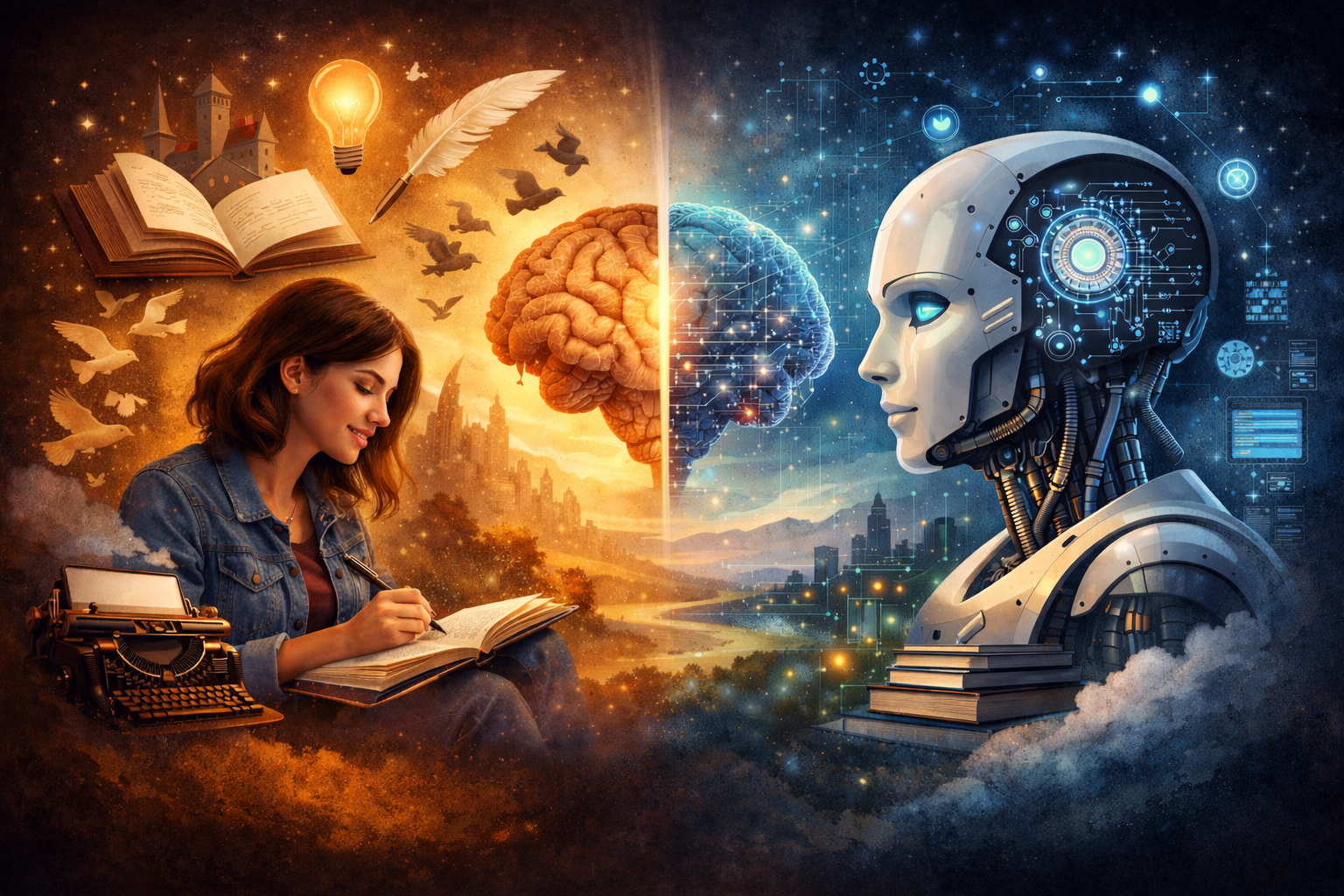
““The universe is made of stories, not of atoms.””
It is a truth universal acknowledged that video killed the radio star. Or at least that was is what Trevor Horn, Geoff Downess, and Bruce Woolley, would have you believe. As we all now have come to see, radio simply rebranded into Podcasts, and it is doing just fine. At the same time that video was threating radio, writers begun to fear that TV would kill books. Later, the internet was supposed to erase attention spans (turns out that was a decade away with the introduction of social media). Today, there is yet another new “foe” arising to challenge the creatives medium: the rise of artificial intelligence.
From ChatGPT composing essays in seconds to AI tools drafting marketing copy or entire novels, machines have once again entered the creative arena. And with their arrival comes a deeply personal question for anyone who writes, teaches, or creates:
How do humans stand a chance?
The answer is the same as it has always been. From the first pictograph covered cave wall to the thinnest keyboard and smallest cell phone screen, we humans have survived every technological advancement the same way. By telling stories.
There are two things we can no longer deny. One AI is here. And, like all things with object permeances, once it is here and we know about it is here to stay. And two, AI is reshaping creativity, critical thinking, and communication, And while we can spend our energy trying to fight the machine, I would like to take a moment to explore what the world with AI looks like and why human storytelling is still irreplaceable, even in an age of algorithms.
How AI is Revolutionizing Writing (For Better and Worse)
I want to start with one clear fact; I am NOT pro AI. I am also not con AI. I am currently neutral AI. Meaning I see both the pros and cons of it and have not yet made up my mind.
However, I will say that in most conversations about AI you can find across social media I do see one topic lacking, and I think it is worth mentioning up front. In today’s conversations around AI and creativity, it’s understandable that concerns are raised. Fears about critical thinking, originality, and authenticity deserve attention. But it’s also worth pausing to reflect on whose voices often shape these critiques.
Much of the skepticism about AI tends to come from neurotypical and able-bodied perspectives, often rooted in traditional expectations of what “good writing” or “real creativity” should look like. Yet for many individuals, including people with physical disabilities, learning differences, or neurodivergent processing styles, AI can serve as a vital bridge, not a barrier.
A 2023 study by Olson, Guzmán, and Kunneman, published through the IEEE/ACM, found that mainstream discourse around AI tools are often shaped by “population bias”, privileging middle-aged, able-bodied, and neurotypical users. This leads to ethical frameworks that overlook how AI might support people with communication difficulties, sensory sensitivities, or processing challenges.
Similarly, in her 2021 paper published in Science Education, Tina Cheuk explains how assumptions about bias in AI often ignore that these technologies can also mitigate existing barriers especially for students with disabilities who face institutional obstacles in traditional assessments and classroom interactions.
Of course, this isn’t to say that AI is perfect or that we should all suddenly be totally fine with it. But to explore these conversations more about how it can be a tool, and like many tools before it (from word processors to voice dictation), its value can often depend on who is holding it.
Rather than dismissing AI outright, it may be more productive to ask: “Who might this help?” And frame our conversations around how we can use it in that capacity. Because the answers aren’t always visible unless we’re intentionally looking for them.
And let’s be honest—AI tools are incredible. Or at the very least mind blowing considering the speed of advancements we have seen over just the past five years. Whether you’re a student, novelist, journalist, or content marketer, AI can now draft, edit, brainstorm, and polish text with breathtaking speed. And if you are any of those…. That’s f$@king scary!
A study by Ajani & Ramaila (2025) highlights how generative AI platforms have enhanced both written and spoken communication skills in academic contexts. Students use AI to scaffold complex ideas, improve vocabulary, and organize their thoughts more effectively. In this way, AI becomes a productivity booster, helping people articulate themselves more clearly and efficiently.
AI also promotes accessibility. Non-native speakers, individuals with disabilities, and those who struggle with traditional writing structures now have a tool to help them express their thoughts more confidently. Which is great for them, not so great for people like me who built a business off tutoring and helping students with their writing. Which is why it is completely understandable while at the foot of an economic plummet writers are a little pissed off at AI for taking their jobs.
But, outside of the shifting job market and finical fears, these gains come with other significant trade-offs.
The Risk of Losing Our Writing Muscles
While AI supports fluency, research warns us about growing over-reliance on machines for cognitive tasks that were once exclusively human. According to Bourne, Williams & Thorpe (2025), a staggering 92% of educators observed a drop in originality and critical thinking among students who heavily rely on AI-generated materials. Rather than developing their own voice, students often replicate AI’s polished but bland tone. Part of me wonders if this is the monkey writing shake spear situation.
Similarly, Ahmedtelba (2025) cautions that while AI can help structure writing, it discourages independent idea formation, often resulting in passive consumption of pre-formed narratives instead of genuine analytical thinking.
In short, we might become better at producing content but worse at thinking things up.
As I am consistently trying to drill into my students, critical thinking isn’t just a skill, it’s a habit. It’s what allows us to evaluate arguments, synthesize information, and build our own perspectives. But when AI provides answers instantly, we may no longer feel the need to ask deeper questions.
Writers and educators are right to be concerned. In a 2025 study, Tang, Yang, & Gu explored how AI-supported learning influenced higher-order thinking. They found that while students produced polished answers, many lost the ability to analyze or reflect critically without technological support. The journey from idea to finished piece is where the real growth happens. When AI skips that journey, we risk trading wisdom for convenience.
But writing is just one facet of human communication. Storytelling, conversation, argumentation, and even silence are parts of how we connect. But what happens when algorithms become our voice?
Uzun (2025) examined how AI-powered writing apps influence expressive skills. The results were sobering: many learners adopted overly generic, emotionally flat language that mimicked AI’s structure, and were frankly, soulless. Meanwhile, Wang (2025) reported that students who relied on AI tools for speaking and writing developed less confidence in verbal expression. Instead of practicing dialogue, debate, or persuasive writing, they outsourced that effort.
If communication is a muscle, then AI may be the crutch that keeps us from walking upright.
The Human Touch: Why Storytelling Still Matters
Here’s the truth that no AI can replace:
Stories are not just content, they’re connection.
Every time we tell a story, we invite others to step into our world. Stories carry emotion, nuance, contradiction, pain, humor, and memory. They’re not just about what happened, but why it mattered. AI can try and replicate structure, but it cannot replicate the lived experience behind the words. It can generate a love letter, but it cannot fall in love. It can simulate grief, but it cannot grieve. I can’t think of any way to punctuate this idea better then to have you stop for a moment and try to remember a time when a song sung in a foreign language made you cry, feel excited, or even impowered (for me that song will always be Dosorugitas form Encanto). You didn’t know the words, but you felt the meaning behind them and that was proof positive AI had nothing to do with it. Maybe later that day you translated the words with an AI translator, but as you were reading over the text it didn’t bring back the same feelings as when you heard it. Now you just had the knowledge of what the words are.
And that’s the difference that needs to be understood when we think about a future with AI. AI adds to the speed in which we can know things, but it will never replace how we communicate the meaning behind that knowledge.
As Girardelli, Merrill, & Ou (2025) argue, AI lacks “semantic empathy” the emotional resonance that defines human communication. Machines don’t feel the weight of a word.
That’s where human storytelling shines.
If you’re a writer, artist, poet, or content creator wondering where you fit into this brave new world (grate book, go read it, worth your time) of algorithms and automation, rest easy. Creativity isn’t just about output. It’s about curiosity. Emotion. Perspective. Risk. Humor. Memory. Irony. Struggle. Celebration.
These aren’t things AI can truly embody. As Chakraborty & Kripalani (2025) note, true storytelling involves cultural nuance, historical memory, and emotional contradiction, areas where AI is still tone-deaf.
So How Should We Use AI?
More than ever, now is the time for our Historians to stand up and shine a light on all the major industrial evolutions and advancements throughout history and tell everyone, “Don’t do it this way it didn’t work. Try this instead”. Humanity has gone through these massive technological shifts before. We have the blueprint to make it through again.
As I mentioned at the beginning of this blog, AI is here and it’s not going anywhere. Which means we are in the next stage of great human exploration. We don’t need to run from AI, we just need to explore it and explore it PRUDENTLY. Like any tool, AI can serve our creativity or suffocate it, depending on how we approach it.
With that in mind, here’s are some ways creatives can use AI as a “second brain” rather than a replacement:
1. Use AI to Explore, Not to Replace
If you haven’t picked it up by now, it’s pretty much the major theme of this blog. AI is excellent for fact generation. Use it to break writer’s block, brainstorm alternatives, or outline your thoughts, but don’t let it do the writing. Keep your voice at the center.
2. Keep the Messiness
Human writing is often messy before it becomes brilliant. Don’t be afraid of drafts, of getting stuck, of changing direction. That’s where the soul of the story lives and AI will never know that struggle.
3. Talk to It
AI can be a sounding board for creative ideas. It can’t generate new critical thought but regurgitate your own ideas back at you, normally in a clearer more direct way. So, when your brain is is scattered and you have a million ideas coming at you at once, just info dump onto AI and let it sort through the chaos for you. Then when you’re ready pick the ideas back up and run with them.
Literally, use it like storage space… as a second brain.
In the End, It’s About the Story
AI doesn’t remember what your grandmother’s laugh sounded like, or how the sky looked on the day you fell in love, or the silent grief of losing someone too soon. Those details are yours. Your memories, your scars, your voice and those are things no machine can replicate.
So, don’t abandon your craft.
As I am consistently telling my students, the only way AI can replace wirers, is if writers stop writing!
Because in a world full of synthetic content, a real voice will always stand out.
If storytelling is how we make sense of the world, then creatives will always have a purpose. AI might be the tool, but you are the author.
So keep writing!
References & Recommended Reading
Ajani, H., & Ramaila, S. (2025). Generative AI vs Future Competencies of Nigerian Public University Students. ResearchSquare
Bourne, P. A., Williams, C., & Thorpe, F. (2025). Generative AI and Student Creativity in Higher Education. ResearchGate PDF
Ahmedtelba, E. (2025). Critical Integration of Generative AI in Higher Education. LJRHSS
Girardelli, D., Merrill, K., & Ou, A. (2025). Teaching and Assessing with AI. Frontiers in Communication
Uzun, Y. (2025). Decoding the Language of Creativity. jcasc.com
Wang, Y. (2025). AI in English Instruction: SWOT Analysis. SHS Web PDF
Chakraborty, U. & Kripalani, M. (2025). AI and the Written Word. ResearchGate
Tang, J., Yang, G., & Gu, N. (2025). AI-Supported Homework and Higher-Order Thinking. Journal of Asia Social Science
Olson, L., Guzmán, E., & Kunneman, F. (2023). Along the Margins: Marginalized Communities’ Ethical Concerns About Social Platforms. IEEE Xplore
Cheuk, T. (2021). Can AI Be Racist? Color-Evasiveness in Machine Learning for Science Assessment. Science Education, Wiley. PDF on ResearchGate