
The Cinematic Classroom: Why Education Is Sliding Toward Video And What That Means for 2026 and Beyond
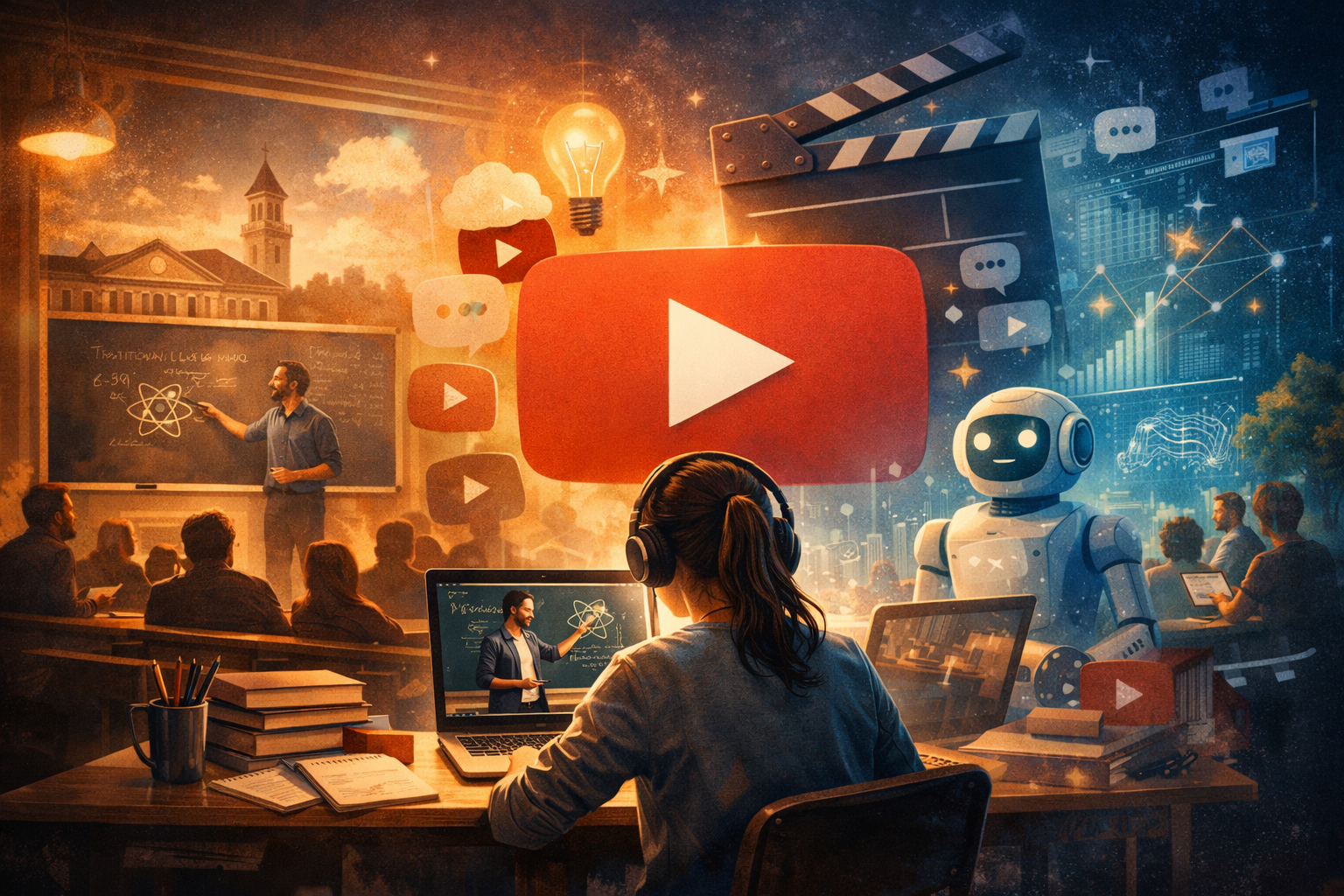
Student learning through educational video on laptop, symbolizing the shift from traditional classroom teaching to digital and cinematic online learning platforms like YouTube and AI-powered tools, with futuristic visuals representing modern education technology in 2026.
Does anyone else remember being forced to sit down for two or three hours in front of a dial-up computer and watch shoddy, almost painful educational videos on subjects so boring no one even wanted to teach them?
Then, after you stumbled out, blinking and bleary-eyed, gathered with your friends near the closest vending machine to complain about how you couldn’t focus and didn’t learn anything anyway, so why were they making you do this?
Does anyone else remember saying to your friends, “…it’s not like video classes are going to catch on”?
Does anyone else besides me remember being so very, very, wrong?
I can still practically taste the cold Coke washing away the monotony of this “new educational platform” and thinking how I would never take a self-guided asynchronous class again because it’s not like I learned anything, and it was just too boring.
Only to find myself sitting at my computer less than ten years later, outlining and designing complete university-level personal curriculums filled with HOURS of YouTube videos, and buying up subscriptions to Udemy, Skillshare, and MasterClass, all for the betterment of my education.
If you’ve ever found yourself captivated by a well-made YouTube video, one where a creator walks through a concept on a blackboard, adds visual metaphors, cuts in relevant examples, and wraps it all in personality, you may have thought, “This is basically a class, but better.” That moment of recognition was a glimpse at the future of education; a preview into a seismic transformation underway in how we learn, teach, and think about education.
What we’re seeing isn’t just a quirky shift in educational trends. It’s a structural evolution being shaped by advancements in technology, decades of cognitive science research, and a generation of learners raised in an environment saturated with modern media. Education is becoming increasingly drive by and consumed be media-natives. This shift in information retention means the future classroom may not involve a physical campus or even a Zoom grid, it may resemble a film studio. Not because education is being “dumbed down” or gamified, but because the tools of cinema, when used thoughtfully, align powerfully with how people learn.
Don’t get me wrong, I love and will always love the traditional classroom setting. It’s pretty much the only time I get out of the house to socialize. On top of that they offer something online learning has yet to grasp. The ability to interact and engage in synaptic thinking through a scalable discussion with peers. This interpersonal interaction is why the lecture format persisted for centuries. It was the pinnacle of teaching, because it was the most efficient way to deliver instruction to many people at once.
But today it takes little to no effort (in the right hands) to create high-quality instruction through recordings just once and distributed it to millions. That single shift in the economics of teaching, one production, infinite reuse, has triggered an overhaul of what it means to “teach well.” The World Bank’s World Development Report 2018 described a global “learning crisis” in which schooling does not necessarily equate to learning. The report emphasized that raising learning outcomes depends not on attendance, but on evidence-based instructional strategies. Well-made educational video, far from being superficial, is often more aligned with such strategies than the average lecture hall.
There is an underlying architecture to high-impact educational video: it reduces attention fatigue, clarifies complex ideas with structured visuals, and embeds learning in emotional and narrative experiences that help the content stick. Kind of like your favorite after school special as a kid, but instead of learning how to count on Sesam Street you’re learning the basics of Maclure fusion by an undergraduate from Standford trying to pay off their student debt. Scholars like Richard Mayer have spent decades uncovering the design principles that make multimedia instruction effective. One of Mayer’s most consistent findings is that people tent to develop a deeper sense of learn from words and relevant visuals combined than from words alone.
This seemingly simple point has profound implications in a media-driven world. The best educational creators often do this instinctively explaining concepts while drawing them out, highlighting key elements, and framing them with metaphors that tap into the viewer’s intuition. These pedagogical techniques are supported by research on multimedia learning and cognitive science.
But there is a catch. Just as video can clarify, it can also confuse. Our working memory, the temporary workspace of the mind, is limited. When a video floods the viewer with rapid transitions, excessive animation, or irrelevant flourishes, learning doesn’t just stall; it deteriorates. This is the essence of John Sweller’s Cognitive Load Theory, which argues that instructional design must be mindful of how much mental effort is being asked of learners at any given time. Mayer and Moreno’s foundational work on reducing cognitive load in multimedia learning supports the claim that learning suffers when we are mentally overwhelmed, no matter how engaging the format.
Educational videos, then, are not automatically effective because they’re visual or entertaining. They are effective when they are deliberately structured to support how people process and store information. In fact, as Ruth Colvin Clark and Richard Mayer outlined in their landmark book E-learning and the Science of Instruction, educational media must balance cognitive demands, sustain attention, and encourage the learner’s active engagement with the content to be truly effective. The guiding mantra isn’t “make it flashy” it’s “make it learnable.”
So, does this approach actually work? The evidence suggests that it can—particularly when it’s not the sole mode of learning. A large meta-analysis by the U.S. Department of Education found that online learning outcomes are comparable to face-to-face instruction, and that blended learning approaches, which combine online content with interaction and hands-on practice, tend to outperform traditional models. Similar conclusions emerge from Mayer’s more recent reviews: video-based learning performs best when it’s grounded in intentional pedagogy, not just passive content delivery. That means cinematic explanation becomes the spine of instruction, while the surrounding muscles—feedback, community, mentorship—continue to do essential work.
There is also a deeper force driving this change: our collective media conditioning.
Whether we like it or not, modern media has reshaped how we expect information to be delivered. The average learner is now primed to expect rapid visual transitions, real-world examples, visual storytelling, and clear pacing. This doesn’t mean students are shallow or incapable of deep thinking. It means that when traditional lectures fail to meet modern standards of clarity and engagement, they begin to feel less effective, not because of diminished attention spans, but because the baseline for instructional quality has shifted. Educators aren’t choosing whether to adapt; they are choosing how well they will.
Looking ahead, it’s possible to envision a future where education functions more like serialized media than semester-bound curricula. Already, we’re seeing the rise of the “creator-professor” educators who blend academic rigor with high production value, cultivating loyal audiences and delivering structured courses in modular formats. These hybrid figures aren’t mere influencers. They are curriculum designers, storytellers, and thought leaders who use modern media to scale both knowledge and inspiration. Their work often mirrors television in structure; episodes, seasons, and arcs, while remaining grounded in rigorous instructional design.
A new wave of Info-rtainment .
Side note, if you’renot sure what info-taining is and you want to learn more about your body and how to take care of it check out Cells at Work and How Heavy Are the Dumbbells You Lift. They are the PERFECT example of info-tainment television.
Learning, too, is becoming increasingly modular. Instead of the semester as the default unit of time, the future may be built around smaller, stackable units, a twelve-minute concept, a short-term project, a badge signaling mastery of a competency. These micro-learning structures align not only with student behavior but with global policy conversations about measurable outcomes. As the OECD has repeatedly noted, the premium on educational attainment is now tied more directly to demonstrated skills and employability than to time spent in buildings. The social demand is shifting from proof of attendance to proof of capability.
In parallel, artificial intelligence is quietly reshaping the back end of the learning process. While cinematic video addresses the challenge of high-quality explanation, AI steps in to handle feedback, personalized practice, and real-time tutoring. What we’re witnessing is the division of labor in teaching: videos provide consistent, scalable explanation, while AI systems already integrated into platforms like Khan Academy and Coursera offer adaptive learning pathways tailored to individual needs.
As UNESCO’s recent reports emphasize, educational systems in the next decade must learn to balance human and machine in a way that preserves equity, fosters critical thinking, and supports democratic access to learning opportunities.
However, the most profound shift may be where learning actually takes place. Increasingly, the classroom is not a room at all, it’s the open web. On the positive side, this shift expands access: anyone with an internet connection can access world-class instruction, develop niche expertise, or reskill for new careers. But there’s a darker side, too. Not all students have reliable devices or bandwidth. Misinformation often masquerades as education, and platform algorithms. not educators, shape what gets seen, shared, and validated. As educational content becomes platformized, it also becomes entangled with questions of control, visibility, and trust.
And here’s the hard truth that often gets overlooked: cinematic content alone does not solve the fundamental learning problem. The MOOCs of the early 2010s were a cautionary tale. While millions enrolled, completion rates remained dismally low. The issue wasn’t the content it was the lack of human structure. Learning, especially when difficult, requires scaffolding: deadlines, mentorship, peer communities, accountability mechanisms. Traditional universities, despite their bureaucratic flaws, still provide much of that structure. If cinematic learning becomes the default delivery system, society will need to reinvent the support systems that make learning sustainable, not just accessible.
This evolution has serious implications for higher education. Universities can no longer defend their value by pointing to lectures. In a world of polished, freely accessible video instruction, that claim rings hollow. What universities still offer, when functioning at their best. is not content delivery, but research, knowledge production, mentoring, and access to real-world application environments. A nursing degree isn’t just a series of explanations; it’s lab time, clinical practice, peer feedback, and supervised experience. That ecosystem remains essential.
The more realistic future is not one in which universities disappear, but one in which their identity shifts. They become certifiers of learning, hubs of applied knowledge, and scaffolds for real-world engagement. Meanwhile, instructional content as the core explanatory material migrates to the cinematic domain. This hybrid model, where learners consume structured video lectures, engage in human-led discussions, build portfolios, and receive AI-guided feedback, is already emerging. It also happens to align with what the research says works best.
The shift toward cinematic education brings us to a moral and political crossroads. This evolution could democratize learning, giving unprecedented access to high-quality instruction across borders and demographics. Or it could deepen existing inequalities, relegating low-income students to decontextualized content while wealthier peers benefit from mentorship, lab access, and credentialed degrees.
As platforms monetize attention and steer visibility, education risks becoming another terrain of algorithmic control. UNESCO’s call for a “new social contract for education” underscores this tension. The transformation of learning must be guided not only by technological innovation but by public responsibility and ethical governance.
In the end, the cinematic classroom is not a gimmick. It is the natural convergence of cognitive science, technological possibility, and shifting cultural expectations. It suggests that teaching, in the coming decades, will increasingly resemble media and that the institutions surrounding it must evolve or risk irrelevance.
📚 References and Related Readings
Brame, C. J. (2016). Effective educational videos: Principles and guidelines for maximizing student learning. CBE—Life Sciences Education, 15(4), es6. https://doi.org/10.1187/cbe.16-03-0125
Clark, R. C., & Mayer, R. E. (2023). E-learning and the science of instruction: Proven guidelines for consumers and designers of multimedia learning (5th ed.). Wiley.
Homer, B. D., Plass, J. L., & Blake, L. (2008). The effects of video on cognitive load and social presence in multimedia-learning. Computers in Human Behavior, 24(6), 1576–1589. https://doi.org/10.1016/j.chb.2007.05.009
Mayer, R. E. (2003). The promise of multimedia learning: Using the same instructional design methods across different media. Learning and Instruction, 13(2), 125–139. https://doi.org/10.1016/S0959-4752(02)00016-6
Mayer, R. E. (2021). Evidence-based principles for how to design effective instructional videos. Journal of Applied Research in Memory and Cognition, 10(3), 363–367. https://doi.org/10.1016/j.jarmac.2021.06.001
Mayer, R. E., & Moreno, R. (1999). Cognitive principles of multimedia learning: The role of modality and contiguity. Journal of Educational Psychology, 91(2), 358–368. https://doi.org/10.1037/0022-0663.91.2.358
Means, B., Toyama, Y., Murphy, R., Bakia, M., & Jones, K. (2010). Evaluation of evidence-based practices in online learning: A meta-analysis and review of online learning studies. U.S. Department of Education. https://tech.ed.gov/files/2013/10/implications-online-learning.pdf
OECD. (2021). Education at a glance 2021: OECD indicators. OECD Publishing. https://doi.org/10.1787/b35a14e5-en
Skulmowski, A., & Xu, K. M. (2022). Understanding cognitive load in digital and online learning: A new perspective on extraneous cognitive load. Educational Psychology Review, 34, 171–196. https://doi.org/10.1007/s10648-021-09624-7
Sweller, J. (1988). Cognitive load during problem solving: Effects on learning. Cognitive Science, 12(2), 257–285. https://doi.org/10.1207/s15516709cog1202_4
UNESCO. (2021). Reimagining our futures together: A new social contract for education. United Nations Educational, Scientific and Cultural Organization. https://unesdoc.unesco.org/ark:/48223/pf0000379707
World Bank. (2018). World development report 2018: Learning to realize education’s promise. https://www.worldbank.org/en/publication/wdr2018